
Free medical stay helps reduce ‘disability deficit’ for Bedford woman
A Bedfordshire woman says providing free accommodation to people undergoing medical treatment away from home is helping tackle the “disability deficit” created by the additional costs of living with a life-changing condition.
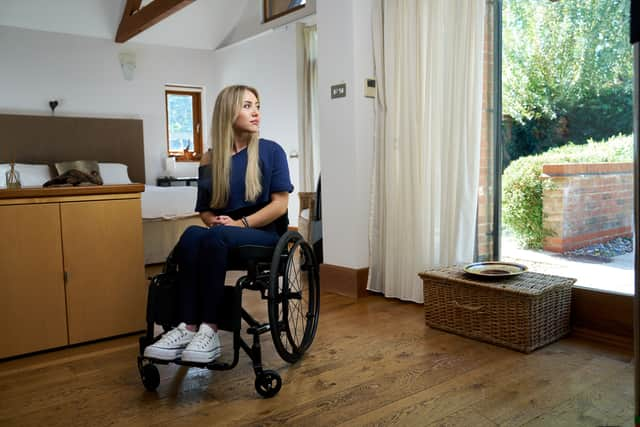

Ellie Dean, who has been living with a spinal cord injury since 2015 when complications during surgery left her paralysed from the waist down, is one of the first beneficiaries of a brand new Free Medical Stays programme.
Launched by Airbnb.org in partnership with several charities across the UK, including Hertfordshire-based Rooprai Spinal Trust (RST), the non-profit organisation has committed £1 million to help provide free temporary accommodation for UK families in need over the next few years.
The funding recently enabled Ellie and her mum to stay in Liverpool while attending an intensive physiotherapy programme, supported by RST.
The 25-year-old said: “The physio centre is more than three hours from where I live, so having somewhere nearby to stay made a huge difference to the entire experience. Travelling when in a wheelchair can already be quite an overwhelming and challenging time, so knowing I had accessible accommodation close to my treatment clinic, which was free, was a real weight off our shoulders.
“It was also really nice to take some of the financial pressure away from my dad, who has helped fund my rehabilitation over the years. It made everything less stressful and allowed me to focus on my recovery.”
The Airbnb accommodation also provided practical benefits that would have been difficult to achieve in a hotel environment.
Ellie, who hit the headlines in 2020 when she abandoned her wheelchair to walk the final mile of the Miami Marathon, said: “Our accommodation really felt like a home from home. After intensive physio all day, it meant I could go back and relax. We had a kitchen, so we could cook healthy meals rather than rely on takeaways or eating out.
She believes the initiative could have a significant impact on others living with spinal cord injuries and added: “Finding specialist physiotherapy close to home can be really difficult. Most people have to travel long distances to access the right support, so accommodation is really important.
“It’s a hidden cost that many people don’t think about, but unfortunately there are lots of additional financial challenges for the disabled. This partnership will definitely be a big help and will go a long way towards reducing the disability deficit caused by the additional costs that many disabled people incur every day.”
Andrew Uttridge, RST co-founder, said: “We are extremely grateful to Airbnb.org to have chosen the Rooprai Spinal Trust to be one of their partnership charities as part of this programme. As Ellie has already highlighted, it is rare for someone to live close to the clinic or specialist providing the pioneering treatment or rehab someone may require. So. with this comes travel and accommodation, both of which create additional expense.
“Providing free accommodation for many of our patrons who require it will make a significant difference and will help reduce the inequalities that so often go hand in hand with disability.”
Research carried out by Airbnb.org found that British patients and families spend over 675,000 nights a year away from home in private accommodation for medical reasons, with more than a third (37 per cent) using their savings to cover the costs.
Nathan Blecharczyk, co-founder and chief strategy officer at Airbnb, said: “Airbnb believes everyone deserves a home, and this is especially true when going through some of the hardest moments of life.
“No family should have to choose between being there for one another and being able to afford somewhere to stay, but we know families spent an average of £1,300 travelling for medical reasons last year, which we wanted to help solve.
“Through Airbnb.org’s Medical Stays programme, we’re working with NHS trusts and non-profit organisations to provide free overnight stays for patients and families near hospitals and committing £1 million so patients can be supported by their loved ones without the financial pressure of paying for accommodation.”