
Ampthill couple return from one of the most dangerous places to be an aid worker
A couple from Ampthill who moved to South Sudan during lockdown have spoken of their five-year mission in Juba – still considered one of the most dangerous places to be an aid worker.
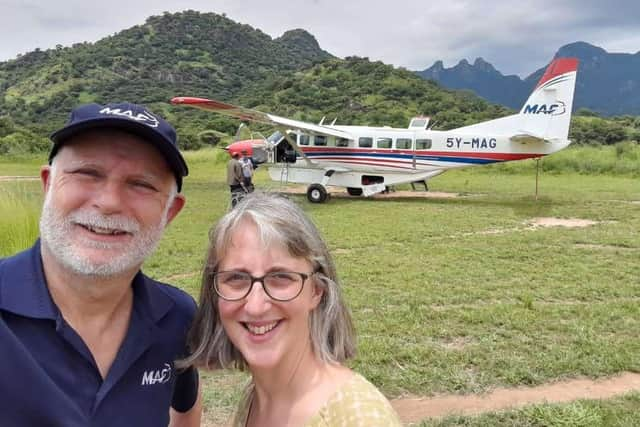
John and Tracey Feil lived in South Sudanese capital Juba with MAF – the world’s largest humanitarian air operator where John was Operations Manager and Tracey a teacher.
They relocated as humanitarian workers for Mission Aviation Fellowship [MAF], an NGO offering a relief, medical and development flight service to some of the most isolated parts of South Sudan.
John – who manged MAF’s flight operations from Juba – admits they return to a different Britain than the country they left in the height of lockdown.

Tracey said: “We have heard stories of intense trauma spanning generations in South Sudan, yet the South Sudanese people sing for joy and have incredible resilience.
"I want to live gratefully and simply with a sense of awareness and gratitude, despite the real – yet very different challenges – existing in Britain today. It’s been a privilege to live alongside people so different from me – yet we found harmony. It has been a wonderful season of our lives.”
The latest Aid Worker Security Report – which almost failed to publish when its funding was pulled during the aid cuts of March of 2025 – indicated that South Sudan is the third most dangerous place to be an aid worker. Yet John and Tracey fell in love with the country, its diverse culture and the people – many of whom carry scars of war, poverty and violence.
Despite its dangerous reputation, John can only recall one instance of feeling afraid while in South Sudan.
He explains: “It was a dispute over a parking space. A group of men became angry, and I found myself being narrowly saved by a colleague from being dragged across the entire carpark. But that was an exception.”
Even a near encounter with a crocodile on the Rive Nile didn’t faze John and Tracey, who praise MAF’s safety training and cultural preparation.
John explained that most attacks on humanitarian workers are against local staff who sadly don’t benefit from the careful security provisions and controlled living environments available to expats.
“We learned how to diffuse challenging conversations and manage risks, like never be in a hurry on the roads, and to stick vigilantly to our curfew on the MAF compound,” John said. “We were never targeted for being aid workers. But the increased insecurity across Juba and the region during our stay did begin to affect my personal resilience. It’s a very harsh place to live.”
During the short winter days back in Bedfordshire, Tracey admits she began her evening wind-down at 3.30pm because she was so used to living indoors after sunset. “It took some adjustment to realise I could go to Tesco at 8pm,” she laughed.
Tracey, who taught at various schools including a centre for vulnerable children, has fond memories of using her teaching skills in a new culture.
She said: “One school I helped at called the Hope and Future Christian Centre, gave children so much more than academics; they were being fed, their wounds were cared for.”
Tracey also joined MAF’s peacebuilding project, which runs workshops all over the country to bring together members of different rural South Sudanese communities who have lived in opposition for decades.
“Being able to work alongside some beautifully inspiring South-Sudanese colleagues, we really unpacked what it means to live at peace with our neighbours, our family and ourselves,” she said.
John’s lasting memory is handing over the ground operations to Malony – a local South Sudanese whom he mentored throughout the five years in Juba.
“Malony was a modest, quiet man working in MAF’s bookings team,” John explained. “He spent a lot of his childhood during the conflict, walking through the bush with his father but came to MAF wanting to be a pilot. However, those plans are now on hold as he supports his wife, daughter and wider family. But he is committed, hungry and skilful. I came to rely on him – He taught me about local and national security; I taught him leadership and management. I’m delighted there is a career ahead of him – it gives me enormous satisfaction to hand over my job to his capable hands.”
Preparing to train more local staff in MAF programme in Guinea later this year, John is grateful for some time reconnecting with friends and family.
“We’ve loved sleepovers with our grandchildren, walking in the woods, digestive biscuits and a good British fish and chips,” he concludes. “And fresh milk in my tea,” added Tracey.