
New report reveals what happened in the moments before fatal train crash near Bedford
A report detailing the moments before the fatal train collision near Bedford in June, has been released.
The Rail Accident Investigation Branch (RAIB) has published an interim report on the ongoing investigation into the Collision, that happened near Estow, on June 19.
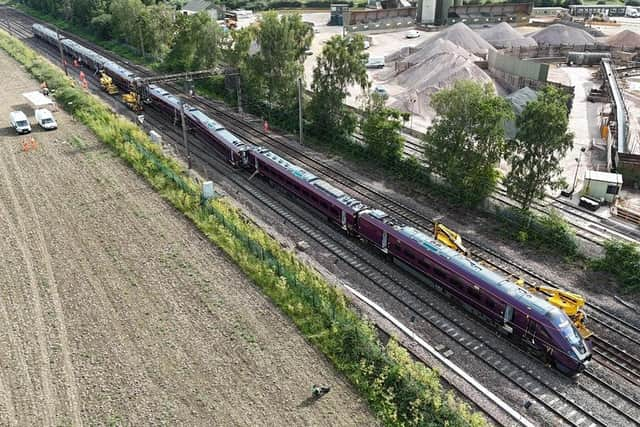

Shortly after 5pm on Friday June 19, a train carrying passengers between Corby and London St Pancras collided with the rear of a stationary Nottingham to London train, derailing both trains.
The crash occurred on Network Rail’s Midland Main Line, around 4 km south of Bedford station. The driver of the Corby service suffered fatal injuries.
Of the estimated 257 people on board the two trains, more than 160 were injured. Significant damage was caused to the trains, both operated by East Midlands Railway.
The RAIB report details that the Nottingham train had come to an unexpected stop, under a signal gantry, following an automatic emergency brake application. The signal was displaying red for danger to protect the stationary train.
Forward-facing CCTV footage from the moving train shows it approached and passed the preceding signal, also displaying red, while travelling at approximately 58 mph (93 km/h) and accelerating when it passed.
The train approached the Nottingham service on a right-hand curve. Analysis of data downloaded from the on-train data recorders or ‘black box’, shows that the driver first applied the brakes around 10 seconds before the collision, while the train was travelling at approximately 76 mph (122 km/h). The data also indicates that the speed of the train had reduced to around 50 mph (80 km/h) at the point of collision.
RAIB says that the reasons why the Corby train passed the signal at danger continue to form part of the ongoing investigation.
A spokesperson explained that investigations, like many others, start by examining the immediate events around an accident and then working outwards to determine why they occurred, and to find any underlying factors. That means that a report published at the early stages of an investigation may contain information about immediate events without necessarily providing an explanation as to why they occurred.
A copy of the full interim report is available on the RAIB website.